
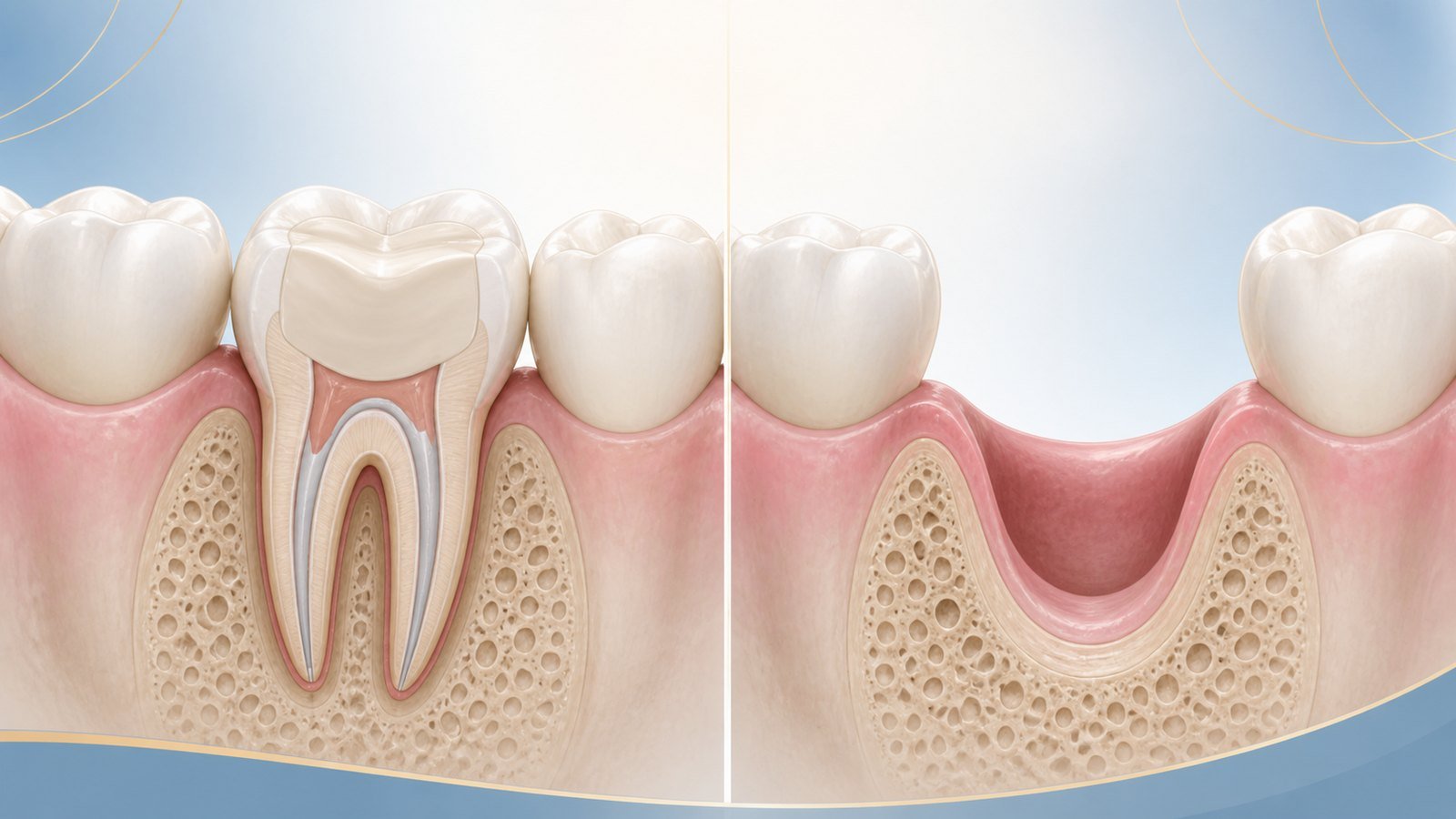
When a tooth is badly decayed, cracked, injured or infected, the immediate question is often: Can the tooth be saved with root canal treatment, or does it need to be extracted?
The answer cannot be determined from pain alone. A dentist needs to identify the source of the symptoms and decide whether the remaining tooth can be predictably restored. That usually requires a health and symptom history, a clinical examination, tests of the tooth and appropriate dental X-rays.
In brief: Root canal treatment removes inflamed or infected tissue from inside a tooth so the natural tooth can remain. Extraction removes the entire tooth from its socket. Saving a restorable natural tooth is often desirable, but extraction can be the more predictable option when the tooth is too damaged, fractured or poorly supported to repair.
What Root Canal Treatment Does
Inside each tooth is a space containing dental pulp. Deep decay, cracks, repeated dental procedures or trauma can inflame or infect that tissue. During root canal treatment, the affected tissue is removed, the canals are cleaned and shaped, and the space is filled and sealed.
The tooth then needs an appropriate permanent restoration. Depending on the tooth and how much structure remains, that may be a filling or a crown. Back teeth often need greater protection from chewing forces. A root-canal-treated tooth should not be considered finished until the restorative phase is completed.
Root canal treatment may be considered when:
- The pulp is irreversibly inflamed or infected.
- The tooth has enough healthy structure to restore.
- A crack or fracture does not make the tooth predictably unrestorable.
- The surrounding gum and bone support are adequate.
- The tooth has a useful role in the bite and a reasonable long-term outlook.
Some cases can be treated by a general dentist. Complex anatomy, retreatment, difficult diagnosis or other clinical factors may make referral to an endodontist appropriate. A referral is based on the individual case; it does not mean that every root canal requires specialist care.
What a Tooth Extraction Does
An extraction removes the tooth from its socket. It may be recommended when the tooth cannot be restored predictably or when another condition makes removal the safer or more dependable plan.
Extraction may be considered when:
- Decay or fracture has destroyed too much tooth structure.
- A severe root fracture prevents predictable repair.
- The tooth lacks enough bone or periodontal support.
- Prior treatment has failed and retreatment is not appropriate or desired.
- The tooth is positioned or damaged in a way that makes restoration impractical.
- The patient and dentist choose removal after reviewing the likely benefits, limitations and alternatives.
Removing the tooth is only one part of the long-term decision. Depending on which tooth is lost and the patient’s needs, the space may be left alone or replaced with a bridge, implant or removable partial denture. Replacement can involve additional treatment, healing time, cost and, sometimes, specialist care.
How the Dentist Decides Whether a Tooth Is Restorable
A useful treatment discussion begins with the diagnosis—not with a procedure selected from a symptom or an online photo.
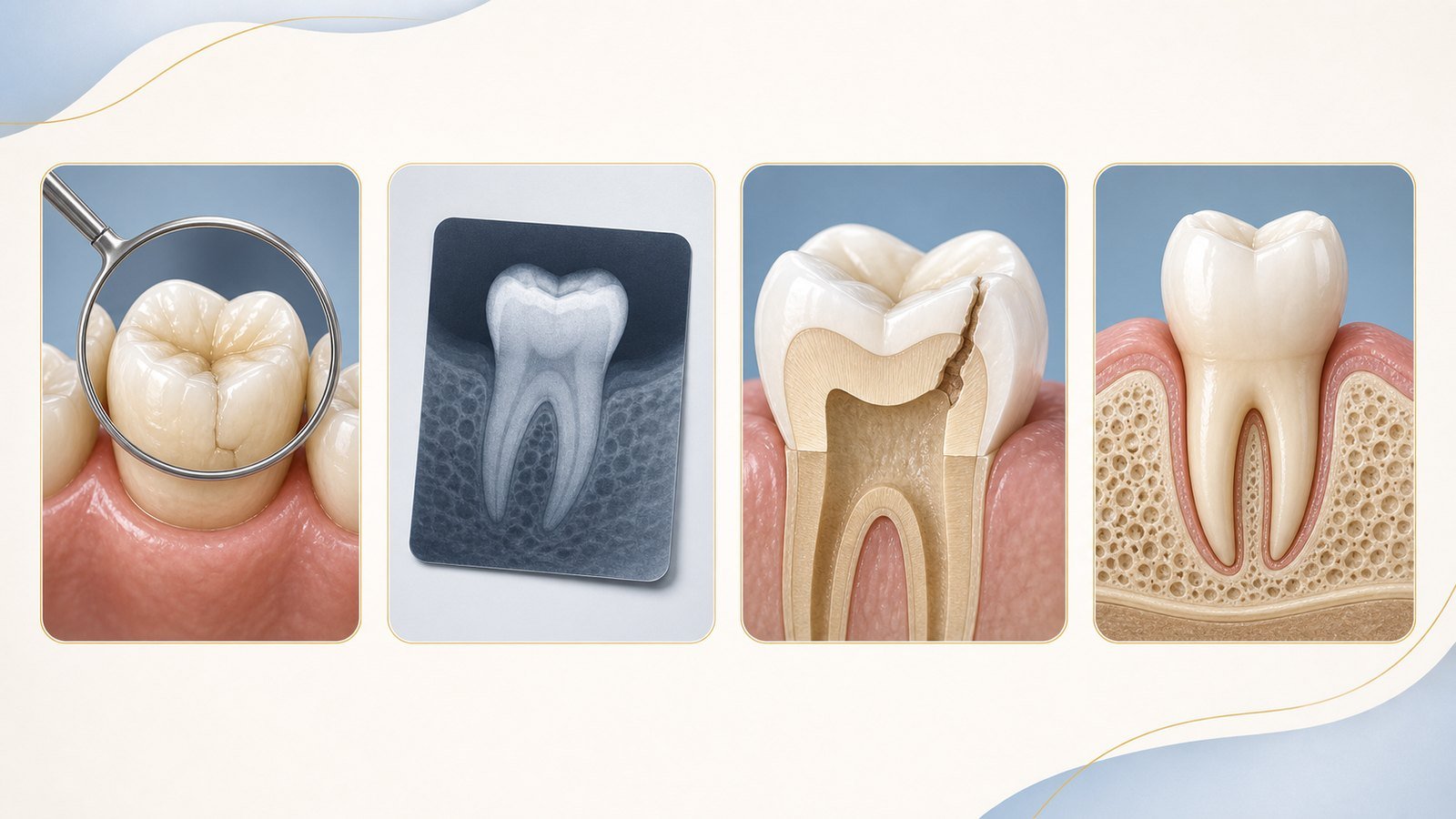
1. Where is the pain coming from?
Pain can come from decay, an inflamed pulp, infection around a root, a cracked tooth, gum disease, bite pressure, sinus conditions or another nearby tooth. The dentist may ask when the pain started, what triggers it, whether it lingers and whether there is swelling, drainage or pain when biting.
2. What do the examination and tests show?
The dentist may inspect the tooth and gums, check for mobility, examine the bite and use temperature, tapping or biting tests. These findings help determine whether the pulp or tissues around the root are involved.
3. What do the X-rays show?
Dental images can reveal deep decay, bone changes near a root, prior treatment, root shape and the amount of supporting bone. X-rays are important, but they are interpreted together with the history and clinical examination. Some cracks and early problems are not obvious on a single image.
4. Can the tooth be rebuilt and protected?
Even technically successful root canal treatment is not useful if there is too little sound tooth remaining for a durable restoration. The dentist evaluates the extent of decay or fracture, the position of the damage and whether a filling or crown can protect the tooth.
5. What is the tooth’s long-term outlook?
Gum health, bone support, bite forces, grinding, oral hygiene, previous treatment and the patient’s health can all affect prognosis. The treatment plan should consider the entire tooth and mouth, not only the nerve inside the tooth.
Root Canal and Extraction Compared
| Question | Root canal treatment | Tooth extraction |
|---|---|---|
| Primary goal | Remove diseased tissue inside the tooth and retain the natural tooth | Remove the tooth and allow the socket to heal |
| When it may fit | The tooth can be cleaned, sealed and predictably restored | The tooth cannot be predictably restored or removal is otherwise preferred |
| What follows | A permanent filling or crown and ongoing dental care | Healing, followed by a discussion about whether and how to replace the tooth |
| Effect on the space | The natural tooth remains in the bite | A space remains unless the tooth is replaced |
| Future treatment | Restoration, monitoring and possible retreatment if disease returns | Possible bridge, implant or partial denture; some sites require additional procedures |
| Main limitation | Long-term success depends on the tooth, final restoration, oral health and ongoing care | The natural tooth is permanently lost, and replacement may require more care |
Neither option is automatically right for every patient. The best choice is the one supported by the diagnosis, restorability, prognosis and the patient’s informed preferences.
Is Extraction Faster or Less Expensive?
An extraction by itself may appear simpler or less expensive than root canal treatment and a final restoration. That comparison is incomplete when the missing tooth should be replaced. A bridge, implant or partial denture can add appointments and expense, and some replacement plans require healing or preparatory care.
Root canal treatment also has more than one component: diagnostic care, the root canal procedure and the permanent restoration. Insurance coverage and patient responsibility vary by plan, tooth and treatment. Ask for a written estimate that identifies each phase, what is included, what may be covered and what could be referred elsewhere.
Star Dental can verify available insurance or Health First Colorado Medicaid information, but verification is not a guarantee of payment. Clinical eligibility, plan rules, annual limits, frequency limits and prior authorization may affect coverage.
Dental Insurance & Payment Guide
Does an Antibiotic Replace Root Canal Treatment or Extraction?
Usually not. For immunocompetent adults with most pulpal and periapical dental pain, the American Dental Association’s guideline prioritizes definitive dental treatment rather than antibiotics alone. Antibiotics may be appropriate when an infection has systemic involvement, such as fever or malaise, or when a clinician identifies another indication. That guideline does not cover every patient or medical circumstance, so children and patients with different health considerations need individualized guidance from the treating clinician.
An antibiotic cannot rebuild a broken tooth, remove infected pulp or seal a root canal. If symptoms improve temporarily, the source may still require treatment. Take antibiotics only as prescribed, and do not use leftover medication.
What to Expect After Either Procedure
Some tenderness can occur after either root canal treatment or extraction. The expected course and instructions differ, so follow the directions provided for your procedure.
After root canal treatment, protect the tooth and complete the permanent restoration on the recommended schedule. Contact the treating office if pain or swelling is severe, worsening or not following the expected recovery pattern.
After an extraction, protect the blood clot in the socket, use medications only as directed and follow the written aftercare instructions. Increasing pain, persistent bleeding, fever, pus, severe swelling or trouble swallowing needs prompt attention.
When Tooth Pain or Swelling Is Urgent
Call a dentist promptly for severe or worsening tooth pain, swelling, a pimple or drainage on the gum, fever with dental pain, a broken tooth or pain when biting. Do not wait for an abscess to “go away”; pain can decrease even when the underlying problem remains.
Call 911 or go to an emergency department for difficulty breathing, speaking or swallowing; swelling that is rapidly spreading toward the eye, neck or airway; uncontrolled bleeding; or serious facial or jaw trauma.
A Practical Way to Prepare for the Decision
At the examination, ask:
- What is the diagnosis, and which findings support it?
- Is the tooth predictably restorable after root canal treatment?
- Will it need a filling or crown afterward?
- What are the main risks and likely prognosis of each option?
- If the tooth is extracted, should the space be replaced?
- Would either procedure or the replacement require referral?
- What are the estimated phases, timing and patient responsibility?
- What symptoms should prompt an urgent call?
Root Canal vs. Extraction FAQs
Is a root canal always better than an extraction?
No. Preserving a restorable natural tooth is often beneficial, but root canal treatment is not appropriate when a tooth cannot be predictably repaired or supported. An examination and X-rays are needed to compare the options.
Can every infected tooth be saved with a root canal?
No. Many infected teeth can be treated, but severe fractures, inadequate bone support, extensive loss of tooth structure or other factors can make extraction more predictable. A complex case may also warrant specialist evaluation.
Does a tooth always need a crown after a root canal?
Not always. The final restoration depends on the tooth’s location, the amount of structure remaining and the forces placed on it. Molars and premolars often need a crown or another protective restoration; the treating dentist should make the recommendation.
Will pulling an infected tooth remove the infection?
Extraction removes the diseased tooth, but the surrounding tissues still must be evaluated and allowed to heal. Drainage, medication or follow-up may be needed depending on the extent of infection and the patient’s health.
Can I wait if my tooth stops hurting?
Pain can decrease when the pulp loses vitality or an abscess drains, but that does not prove the tooth healed. Arrange an evaluation if pain was severe, recurrent or accompanied by swelling, drainage, fever or trauma.
Which recovery is easier: root canal treatment or extraction?
Recovery varies by tooth, infection, procedure complexity and individual health. Both procedures are generally performed with local anesthetic, and temporary tenderness is possible. Ask what is expected for your specific treatment rather than relying on a universal comparison.
Do I have to replace an extracted tooth?
Not every space is managed the same way. The answer depends on the tooth, bite, chewing needs, neighboring teeth and treatment goals. Ask about the consequences of leaving the space and the relative benefits of a bridge, implant or removable option.
Can antibiotics help me avoid both procedures?
Antibiotics alone usually do not remove infected pulp, repair a crack or eliminate the dental source of pain. Definitive treatment is commonly still needed. A dentist should determine whether an antibiotic is indicated.
Talk With Star Dental
If you have a painful, cracked or infected tooth, call 303-222-1414 for current availability. Star Dental serves Denver and Lakewood seven days a week, welcomes new patients, accepts Health First Colorado Medicaid and most PPO plans, and has Spanish-speaking staff available every day. Treatment recommendations depend on the examination and diagnostic findings.
Sources
- American Association of Endodontists. Root Canal vs Extraction. https://www.aae.org/patients/root-canal-treatment/what-is-a-root-canal/root-canal-vs-extraction/
- American Association of Endodontists. Root Canal Explained: Step-by-Step Treatment Guide. https://www.aae.org/patients/root-canal-treatment/what-is-a-root-canal/root-canal-explained/
- American Association of Endodontists. Treatment Options for the Diseased Tooth. https://www.aae.org/patients/root-canal-treatment/endodontic-treatment-options/dental-implants/treatment-options-diseased-tooth/
- American Dental Association. Antibiotics for Dental Pain and Swelling Guideline. https://www.ada.org/resources/research/science/evidence-based-dental-research/antibiotics-for-dental-pain-and-swelling
- MedlinePlus Medical Encyclopedia. Tooth abscess. https://medlineplus.gov/ency/article/001060.htm