
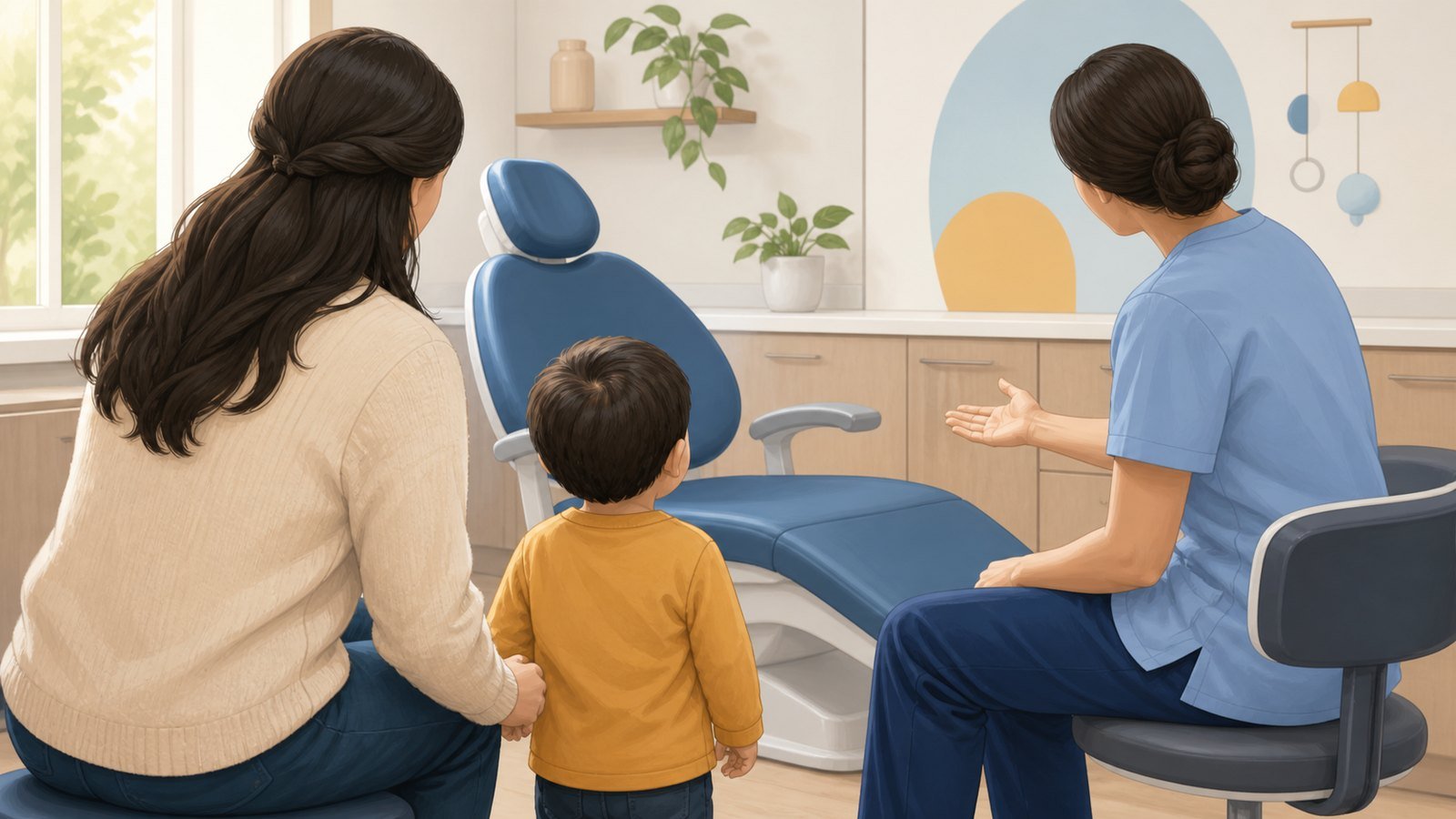
A child’s first dental visit is an opportunity to check early growth, look for signs of tooth decay and help a family build comfortable routines before there is an emergency.
The American Dental Association recommends scheduling the first visit within six months after the first tooth appears and no later than the first birthday. The American Academy of Pediatric Dentistry likewise encourages families to establish a dental home by 12 months of age.
That timing surprises many parents because a one-year-old may have only a few teeth. Early visits are intentionally preventive. They allow the dentist to assess the mouth, answer questions about brushing, fluoride, feeding and habits, and recommend follow-up based on the child’s individual cavity risk.
Why Visit by the First Birthday?
Baby teeth can develop cavities soon after they erupt. Untreated decay can cause pain and infection and can affect eating, speaking, sleeping and learning. An early visit helps parents recognize risk factors and learn what they can do at home.
An age-one visit can help with:
- Checking newly erupted teeth and oral development.
- Identifying early signs of tooth decay or injury.
- Assessing the child’s individual cavity risk.
- Reviewing brushing, fluoride and home-care techniques.
- Discussing feeding patterns, sugary drinks and frequent snacking.
- Answering questions about teething, pacifiers and thumb or finger habits.
- Creating a plan for routine care and dental injuries.
- Making the office more familiar before complex care is needed.
The first visit is not a test of whether a baby or toddler can sit perfectly still. It is a chance for the child, caregiver and dental team to begin a relationship.
When to Schedule Sooner
Do not wait for the first birthday if a tooth has erupted and you notice a concern. Call for advice if your child has:
- A white, brown or dark area on a tooth.
- A visible hole, chipped tooth or sharp edge.
- Tooth pain, pain while eating or unexplained avoidance of foods.
- Swelling, a gum pimple, drainage, fever with dental symptoms or facial swelling.
- A fall or injury involving the mouth or teeth.
- Bleeding that does not stop.
- A tooth that is loose or displaced after trauma.
- A medical or developmental condition that may affect oral care.
Call 911 or go to an emergency department for trouble breathing or swallowing, uncontrolled bleeding, serious head or facial trauma, loss of consciousness or rapidly spreading swelling toward the eye, neck or airway.
How to Prepare Your Child
Simple preparation is usually best, especially for babies and toddlers.
Use calm, positive language
Tell your child that the dental team will count and look at their teeth and help keep their mouth healthy. Avoid frightening stories, threats or detailed descriptions of procedures that may not happen. The ADA advises parents not to use a dental visit as punishment and to keep their own anxiety from shaping the child’s expectations.
Choose a good time of day
When possible, schedule when your child is normally rested and cooperative. For some children that is a morning appointment; for others it is after a regular meal or nap. Follow any eating instructions the office gives you.
Keep the explanation short
A brief explanation on the day before or morning of the visit is often enough. Reading a friendly book about the dentist or practicing “open wide” while counting teeth can make the idea familiar without building suspense.
Tell the office about individual needs
Before the appointment, share any developmental, sensory, mobility, communication or medical needs. Also mention strong dental anxiety, previous difficult health-care experiences or accommodations that help your child. The team can explain what the office can provide and whether a different setting or referral would be appropriate.
Star Dental has a wheelchair-accessible office and Spanish-speaking staff available every day. Specific accommodations and language assistance should be requested when scheduling so the team can prepare.
What to Bring
Bring or be ready to provide:
- The parent or legal guardian’s photo identification.
- Current dental insurance or Health First Colorado Medicaid information.
- A list of the child’s prescription and nonprescription medicines, allergies and medical conditions.
- The names and contact information of the child’s physician and any previous dentist.
- Relevant dental records or X-rays, if the child has received care elsewhere.
- Information about prior surgeries, hospitalizations or reactions to medicines.
- Questions about brushing, fluoride, feeding, teething or oral habits.
- A familiar comfort item if it helps your child feel secure.

If someone other than a parent or legal guardian will bring the child, call before the visit to ask what consent or authorization documents are required. Do not assume another adult can approve examination, X-rays or treatment.
What May Happen at the First Visit
The appointment is tailored to the child. A very young child’s visit may be shorter and more focused on examination and caregiver guidance than an older child’s new-patient appointment.
1. Health and dental history
The team reviews the child’s health, medicines, allergies, feeding patterns, home care, dental symptoms and any past injuries or treatment. Accurate history helps the dentist plan safely.
2. An age-appropriate examination
The dentist checks the teeth, gums, bite and other oral tissues and considers growth and development. The child may sit independently or be positioned with a caregiver, depending on age, cooperation, safety and office protocol.
3. Cavity-risk assessment
The dentist considers previous decay, visible plaque or enamel changes, diet, fluoride exposure, dry mouth, family history, home-care routines and other individual factors. The result helps determine preventive recommendations and when to return.
4. Cleaning and preventive care when appropriate
The visit may include gentle cleaning, fluoride varnish or another preventive service if it is clinically appropriate and the child can tolerate it. Not every child receives every service at the first appointment.
5. Parent and caregiver guidance
The team may demonstrate brushing, discuss an age-appropriate amount of fluoride toothpaste, review snacks and drinks, and answer questions about teething or sucking habits. Recommendations should be individualized rather than copied from a generic schedule.
6. A follow-up plan
The dentist explains findings, recommends the next visit and discusses any needed treatment or referral. Follow-up timing is based on the child’s risk and needs; there is no one schedule that fits every child.
Will My Child Need Dental X-Rays?
Not automatically. Dental X-rays are selected when the information is expected to help diagnose or manage the child’s condition. The decision can depend on age, symptoms, previous decay, tooth spacing, injury, growth and whether useful current images already exist.
If another dental office has recent X-rays, ask that office to send them before the appointment. The dentist will review whether previous images answer the current clinical question and recommend any additional images that are needed.
Ask why an image is recommended and how it will affect care. The team can also help review available insurance benefit information for the visit.
Making the Visit Positive Without Promising Perfection
Some children are curious and cooperative immediately. Others need more time, shorter steps or another visit before they are comfortable. Crying, hesitation or needing a break does not mean the appointment failed.
Helpful goals for a first visit can be:
- Entering the office and meeting the team.
- Sitting in or approaching the dental chair.
- Letting the dentist count some or all teeth.
- Allowing a brief examination.
- Giving the caregiver a prevention plan.
The team should not force a routine preventive procedure merely to complete a checklist. When necessary care cannot be completed safely or comfortably, the dentist can discuss behavior guidance, a staged plan or referral based on the child’s needs.
Insurance and Health First Colorado Medicaid
Star Dental accepts Health First Colorado Medicaid and most PPO plans. Bring current information even if you believe the office already has it. Eligibility, covered services, frequency limits, prior authorization and patient responsibility can change and must be checked for the individual child.
If you do not know the child’s Medicaid member number, call before the visit and ask which identifying information to bring. The team can explain whether an eligibility check can be attempted and whether more information is needed. Coverage verification is not a guarantee of payment or authorization.
Dental Insurance & Payment Guide
First Dental Visit FAQs
When should my child first see a dentist?
Schedule within six months after the first tooth appears and no later than the first birthday. Call earlier if you see decay, pain, swelling, injury or another concern.
What if my child is already older than one and has never been to a dentist?
Schedule now rather than feeling embarrassed or waiting for symptoms. The dentist can assess current health, address concerns and create an age-appropriate prevention plan.
Will my baby get a full cleaning at the first visit?
Maybe, but not every first visit includes the same services. The dentist considers the child’s age, oral health, comfort and clinical needs. Examination and caregiver guidance are important outcomes even when a full cleaning is not completed.
Does every child need X-rays at a first appointment?
No. X-rays are selected according to clinical need, symptoms, cavity risk, development and the availability of useful prior images. Ask why an image is recommended.
Can I stay with my child during the examination?
Caregiver participation depends on the child’s age, needs, safety and office protocol. Ask when scheduling if you have a preference or if your child needs a specific accommodation.
What if my child is afraid or cries?
That can be normal. Tell the team about anxiety before the visit. The appointment can be adapted into smaller steps, and the dentist can discuss whether another visit, behavior guidance or referral is appropriate.
What records should I transfer from another dentist?
Ask for relevant treatment notes and recent dental X-rays. Provide the previous office’s contact information early enough for records to arrive. The new dentist decides whether those records are sufficient for current care.
Who must bring a minor to the appointment?
A parent or legal guardian is the safest default. If another adult will attend, call first to learn which written consent, identification or guardianship documents Star Dental requires.
Does Star Dental accept Medicaid for children?
Star Dental accepts Health First Colorado Medicaid. Active eligibility, covered services, authorization and benefit rules must be verified for each child and date of service.
Is Spanish help available for families?
Yes. Spanish-speaking staff are available every day. Request Spanish assistance when scheduling so the office can prepare for the visit.
Schedule a Child’s Dental Visit
Star Dental welcomes children and families from Denver and Lakewood and is open seven days a week. Call 303-222-1414 for current appointment availability. Please call first to reserve an appointment, including for routine first visits, so the team can allow appropriate time.
Sources
- American Academy of Pediatric Dentistry. The Importance of the Age One Dental Visit. https://www.aapd.org/globalassets/media/policy-center/year1visit.pdf
- American Academy of Pediatric Dentistry. Periodicity of Examination, Preventive Dental Services, Anticipatory Guidance/Counseling, and Oral Treatment for Infants, Children, and Adolescents. https://www.aapd.org/globalassets/media/policies_guidelines/bp_periodicity25.pdf
- American Academy of Pediatric Dentistry. Policy on the Dental Home. https://www.aapd.org/research/oral-health-policies–recommendations/Dental-home-2/
- American Dental Association, MouthHealthy. Healthy Habits — Babies and Kids. https://www.mouthhealthy.org/life-stages/babies-and-kids/healthy-habits-babies-and-kids
- Centers for Disease Control and Prevention. Oral Health Tips for Children. https://www.cdc.gov/oral-health/prevention/oral-health-tips-for-children.html
- American Dental Association, MouthHealthy. Dental Emergencies. https://www.mouthhealthy.org/dental-care/dental-emergencies/