
You do not automatically need all four wisdom teeth removed because one hurts. Sometimes treating one tooth is appropriate; sometimes two, three or all four have reasons for removal. Each tooth needs its own assessment. Pain is important, but a painless tooth can still have disease or pose a risk to its neighbor. Healthy, useful wisdom teeth that can be cleaned may be kept with professional monitoring.
You may be ready to deal with the painful tooth and surprised when the conversation turns to the others. It is reasonable to ask why. Before deciding on a treatment plan, separate two questions: Which teeth need treatment? And, if more than one does, should they be treated together or in stages?
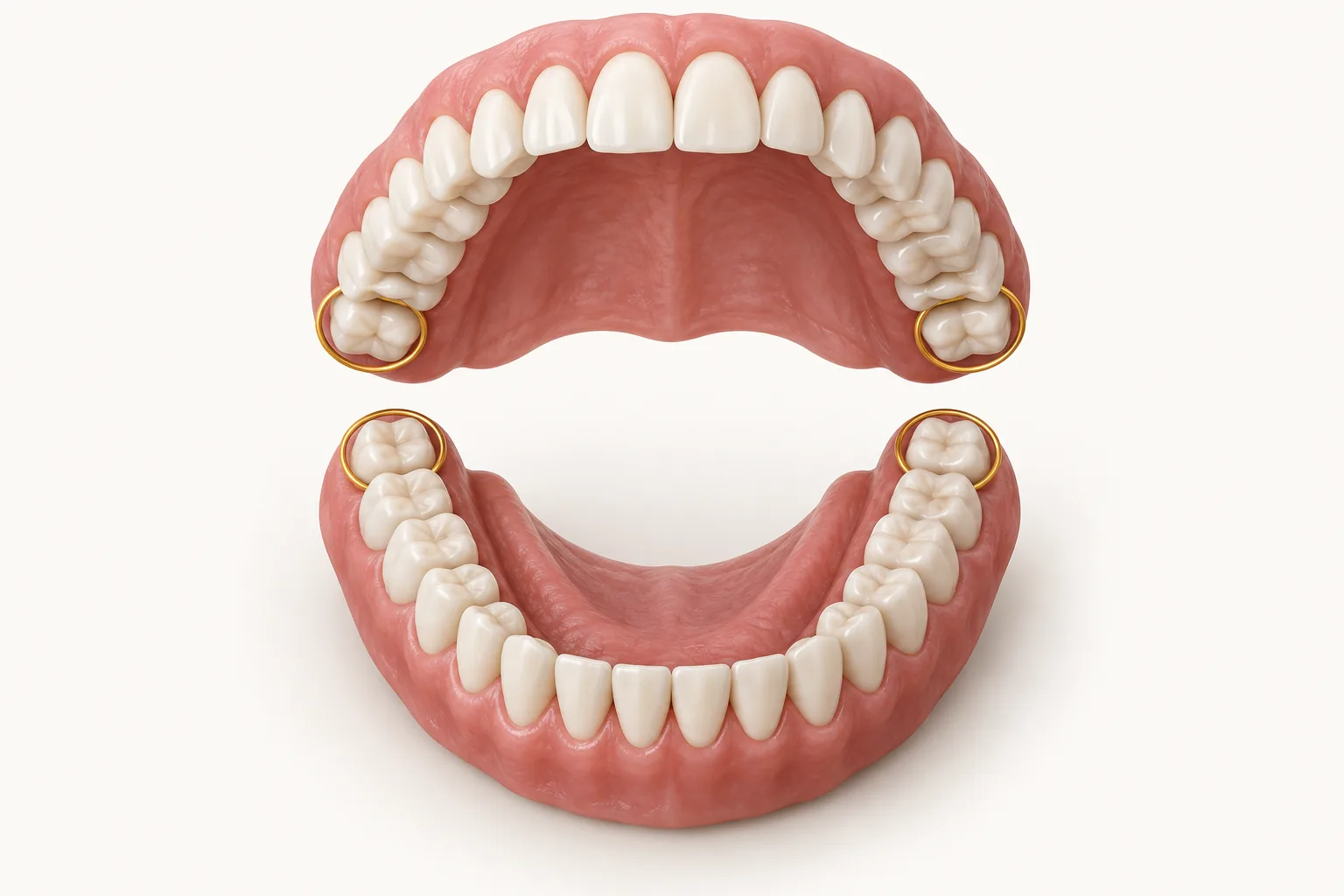
Only one wisdom tooth hurts. Why look at the others?
Pain tells the dentist where to start investigating, not how many teeth should come out. A sore area might involve inflammation around a partly erupted tooth, decay, the neighboring molar or another source. The first step is identifying the cause rather than assuming that the last tooth in the row is responsible.
The other wisdom teeth may be completely different: one fully grown in, another partly covered by gum, and another still beneath the surface. The American Dental Association identifies infection, gum disease, certain decay and damage to nearby teeth among reasons removal may be recommended.[1]
So “only one hurts” does not prove that only one needs care. Equally, it does not justify removing the others without an explanation. Ask the dentist to describe the findings for each tooth, including any tooth they recommend leaving in place.
What should be assessed for each wisdom tooth?
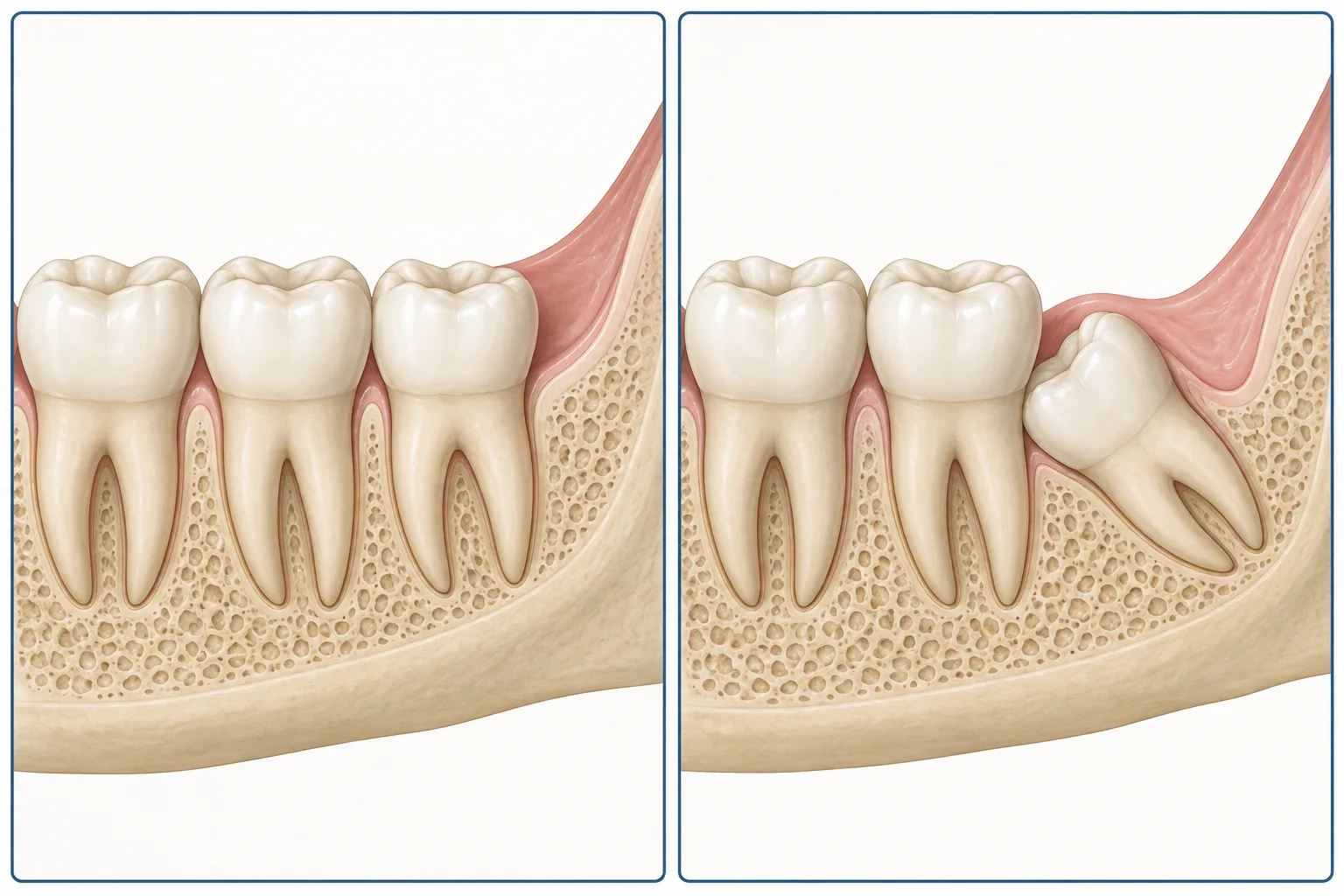
A useful recommendation connects the examination to the tooth’s long-term role in your mouth. The AAOMS assessment framework includes position, function, decay, gum health and the relationship to adjacent structures.[2]
Position and cleaning
Has the tooth grown in fully, or is it partly covered or trapped? Can you reach its back surface and clean between it and the next molar?
Health and nearby teeth
Is there decay, repeated gum inflammation, infection or other disease? Is the second molar—the tooth just in front—being affected?
Function and treatment risk
Does the tooth contribute to the bite? What are the risks of keeping it versus removing it, considering its roots, nearby anatomy and your health?
The tooth above or below it also matters when assessing the bite. But removing a lower wisdom tooth does not automatically mean its upper partner must come out. Ask what specific finding supports treatment of that opposing tooth.
Your medical history, medicines and previous dental experiences belong in this discussion. Bring a current medication list and mention problems you have had with healing, anesthesia or dental anxiety. Do not stop prescribed medicines on your own.
When might the plan involve one, several or all four?
There is no ideal number to remove. The right number follows the findings—not a rule that wisdom teeth must be treated as a set. These are possible planning patterns, not diagnoses you can make at home.
| Possible plan | What could support it? | Ask before deciding |
|---|---|---|
| Remove one | One tooth has a clear treatment need; the others can reasonably be retained and monitored. | “What follow-up will the remaining teeth need?” |
| Remove two or three | Several teeth have concerns, while another has a different risk–benefit balance. | “What is the reason for each tooth included?” |
| Remove all four | Assessment supports removal of each of the four teeth, even if only one currently hurts. | “Which findings are present disease, and which are future-risk concerns?” |
| Monitor some or all | Keeping the assessed teeth is reasonable, with an agreed plan to review them. | “What changes would lead you to recommend treatment?” |
If there is a problem with one tooth, ask whether it needs removal or whether another treatment is appropriate. An extraction consultation should clarify your options, not commit you to a preset number of extractions. Our wisdom teeth removal service page explains how to arrange an evaluation.
Can healthy wisdom teeth stay?
Yes, they sometimes can. Mayo Clinic explains that wisdom teeth may not need removal when they are healthy, fully erupted, positioned well in the bite and accessible for daily cleaning.[3] Keeping them means continuing to look after and assess them, not considering the issue permanently closed.
A painless impacted tooth presents a more nuanced question. “No symptoms” and “no disease” are not interchangeable. If examination and imaging show neither symptoms nor disease, the decision still involves the tooth’s circumstances and your preferences. A Cochrane review found insufficient evidence to settle removal versus retention for all asymptomatic, disease-free impacted wisdom teeth.[4]
That uncertainty does not mean either choice is careless. It means a blanket internet rule is not enough. Ask about the expected benefits, the uncertainties and the monitoring plan if you keep the tooth.
If several need removal, should you do them together or in stages?
Once you understand which teeth are recommended for treatment, discuss scheduling. A combined appointment and a staged plan address the same question differently: how to organize the care that is actually needed.
Treatment together may consolidate procedure appointments, transportation arrangements and time away from work or school. But a convenient schedule is not an independent reason to remove a tooth that otherwise should be kept. Ask what the combined procedure would involve in your case.
Staged treatment means completing planned treatment over separate visits. It may be worth discussing when your health, the teeth’s differing complexity, anxiety or practical circumstances make one session difficult. The clinician needs to assess whether delaying any tooth is reasonable. Staging also means arranging additional procedure visits and recovery periods.
Do not assume that two visits are always safer, or that one visit always produces an easier recovery. Ask for a comparison tailored to your plan. “I can arrange help this month, but not next month” or “I am worried about coping with a longer appointment” gives the team useful information without deciding the clinical question for them.
For the financial questions, request an itemized estimate for the proposed options. Our Denver wisdom teeth removal cost guide covers cost considerations; the number of teeth alone does not establish your quote or benefit coverage.
What do the examination and X-rays add?
The dentist checks what is visible and uses appropriate imaging to understand what is not. X-rays can help assess tooth position, roots, neighboring teeth and relevant surrounding structures. The type of imaging depends on the clinical question; a scan is not automatically needed simply because you have four wisdom teeth.
The ADA recommends choosing dental X-rays based on the history, examination and information needed for care. Existing images may be useful, so ask your previous office to transfer them when appropriate.[5]
Ask the clinician to walk around the image with you: upper right, upper left, lower right and lower left. For each tooth, you should be able to identify the recommendation, the reason and the timing.
An image is part of the assessment, not the entire answer. Your symptoms, gum examination, health history and preferences still matter.
Does removing more teeth mean you must be asleep?
No single tooth count determines the anesthesia plan. Local anesthetic numbs the treatment area; sedation may be considered according to your needs, the procedure and the care setting. Discuss available options and preparation requirements with the treating team.[6]
You may feel pressure or movement during removal, which differs from pain. Tell the clinician if you feel pain so they can reassess your comfort. Follow your own team’s instructions about eating, medicines, an escort and driving rather than borrowing someone else’s surgery checklist.
A single tooth can be technically complex, while several fully erupted teeth may present different challenges. Ask about the actual procedure, not just its tooth count. For aftercare planning, see our separate wisdom teeth removal recovery guide.
How soon should you decide—and when is it urgent?
Ask the dentist to distinguish urgent treatment from care that can be scheduled and teeth that can be monitored. “We recommend removal” should lead to a discussion of timing, not an assumption that every tooth must be treated immediately.
If one tooth is painful, call for assessment even if you are undecided about the others. Describe how long it has hurt, whether symptoms are worsening and whether eating or sleep is affected. Sorting out the painful area can begin without you selecting a one-tooth or four-tooth appointment yourself.
Symptoms that should not wait
Seek urgent dental advice for swelling, fever, pus or a bad taste with pain, or increasing difficulty opening your mouth. For trouble breathing or swallowing, severe or rapidly spreading mouth or facial swelling, or swelling involving the eye, seek emergency medical care. Call 911 for breathing difficulty; do not wait for an online dental request to be answered.[7]
Before leaving a consultation, write down which teeth are planned for treatment, which will be watched and when the next step should happen. A clear plan is more helpful than “we will deal with the others later.”
Common questions about removing one or all four wisdom teeth
Can I have just one wisdom tooth removed?
Yes, when assessment supports that plan. Ask why that tooth needs removal and what care or monitoring is recommended for the others. Having one removed does not obligate you to remove the rest, but it does not establish that the remaining teeth are healthy.
Do all four wisdom teeth need to come out at the same time?
No. First establish whether each tooth needs removal. If several do, discuss whether combined or staged treatment is appropriate. The decision should account for your health, procedure complexity, comfort needs and practical arrangements, with safe timing for any delayed treatment.
Why remove a wisdom tooth that does not hurt?
A tooth can have disease or affect an adjacent tooth before you notice pain. Removal may also be discussed because of assessed future risk. Ask the dentist to distinguish an existing problem from a preventive recommendation and explain the alternatives for that tooth.
If a lower wisdom tooth is removed, must the upper one come out too?
Not automatically. The dentist should assess the upper tooth’s position, health, cleaning access and role in your bite. Ask why it is included in the plan rather than assuming wisdom teeth always need to be removed in opposing pairs.
Can I wait until the other wisdom teeth start hurting?
Pain alone is not a reliable monitoring plan. If you keep teeth, agree on professional reviews and any indicated imaging. Ask what findings are being watched and which new symptoms should prompt an earlier call. Do not delay a recommended urgent assessment while waiting for more pain.
Is removing four teeth four times harder than removing one?
No useful formula converts tooth count into difficulty or recovery time. Position, access, roots and your health also matter. Ask the treating clinician what your proposed procedure involves and what help or time away from normal activities you should arrange.
Can I get a second opinion before agreeing to all four?
Yes. Request the findings, proposed treatment plan and relevant images so another clinician can evaluate the recommendation. Tell both offices about pain, swelling or other urgent symptoms; seeking another opinion should not mean ignoring a problem that needs prompt attention.
Will Colorado Medicaid cover one tooth or all four?
Coverage depends on your current eligibility, benefits and the proposed care, not simply the number of teeth. Review our Medicaid dental care page and ask the team to verify your specific plan. This guide does not confirm payment or authorization for any extraction.
Get a tooth-by-tooth recommendation in Denver
Call Star Dental at 303-222-1414 to arrange an assessment. Tell the team whether one area hurts or you are seeking advice about a recommendation to remove several wisdom teeth. Bring available records and benefit information.
Same-day appointments may be available. Call first to confirm availability and reserve a time before coming in. Treatment depends on the examination. Our contact page has location and appointment information.
Sources and editorial information
Prepared by Star Dental. This guide offers general education, not an individual diagnosis or a substitute for examination. Treatment recommendations require your dental team’s assessment.
- American Dental Association, MouthHealthy: Wisdom Teeth.
- American Association of Oral and Maxillofacial Surgeons: Management of Third Molar Teeth.
- Mayo Clinic: Wisdom Teeth Removal—When Is It Necessary?.
- Cochrane Oral Health: Surgical Removal Versus Retention of Asymptomatic, Disease-Free Impacted Wisdom Teeth.
- American Dental Association, MouthHealthy: X-rays.
- NHS Inform: Wisdom Tooth Removal.
- NHS: Dental Abscess.
- Mayo Clinic: Wisdom Tooth Removal.
- NHS: Wisdom Tooth Removal.