
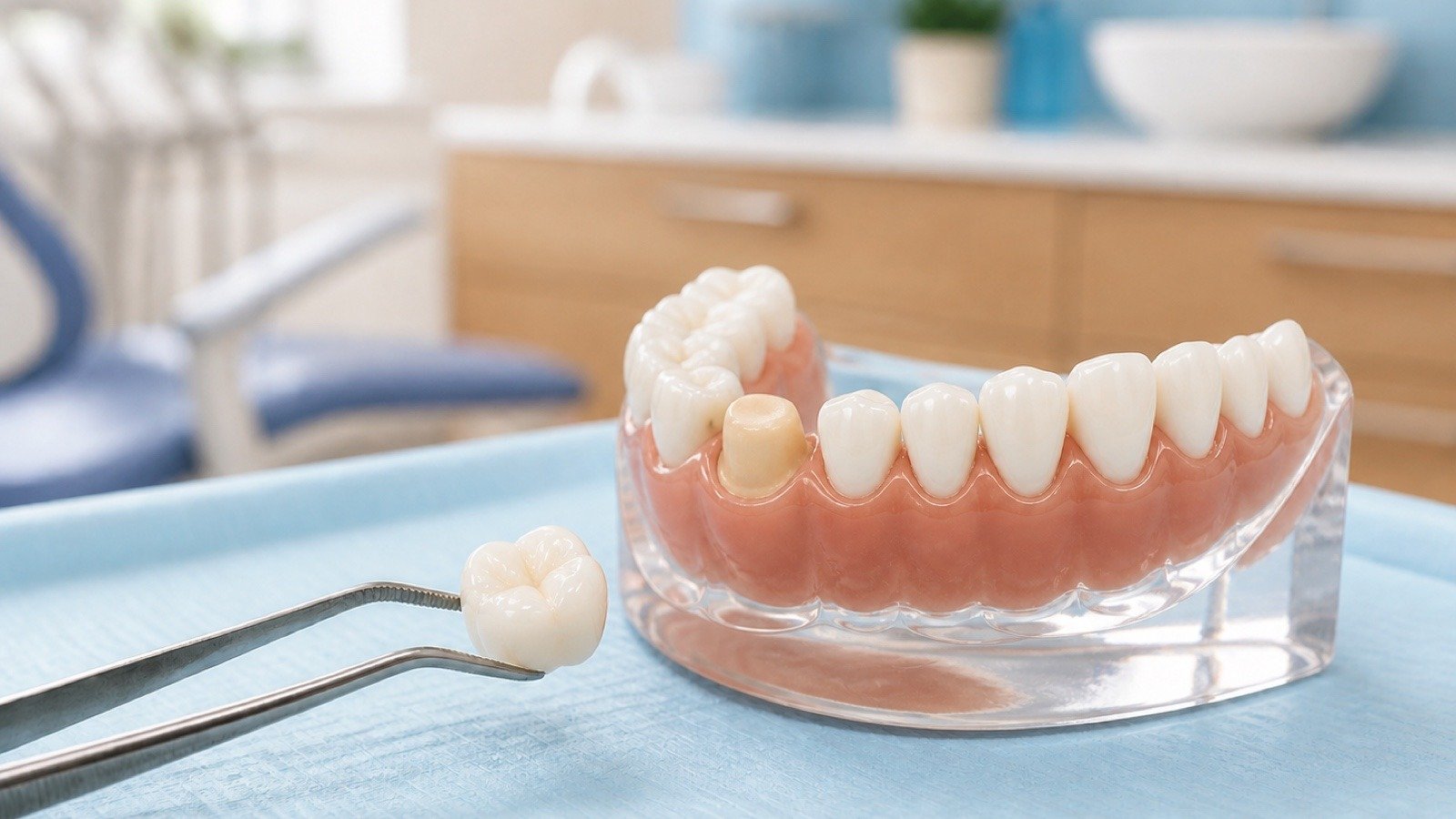
If a temporary crown falls off, save it, protect the tooth and call the dentist who prepared the tooth as soon as possible. When the crown is intact and still fits correctly, a dentist may be able to clean and recement it. If it is cracked, distorted or missing, the next step depends on the condition of the prepared tooth, the crown appointment timeline and whether the treating office has the original scan, impression or matrix.
Do not force the crown back into place and do not use superglue or another household adhesive. A prepared tooth may become sensitive to temperature, sweets, air or pressure after the provisional crown comes off. Even if the tooth does not hurt, it should be assessed promptly because the provisional also helps protect the tooth and preserve the space and bite planned for the final crown.
What to do right away
- Remove the loose crown from your mouth. This helps prevent accidentally swallowing or inhaling it. If you already swallowed it and have coughing, choking, breathing difficulty or chest symptoms, seek emergency medical care.
- Keep the crown. Rinse it gently with water without scraping the inside. Store it in a clean, closed container or small bag and bring it to the appointment.
- Look, but do not probe. Note whether the crown appears whole, cracked or misshapen and whether a piece of tooth seems to be inside it. Do not insert tools into the crown or around the prepared tooth.
- Call the office that prepared the tooth. That team has the treatment plan, tooth preparation details, original impression or digital scan, laboratory case and expected date for the final crown.
- Protect the tooth while you wait. Chew on the opposite side and avoid sticky, hard, crunchy and very hot or cold foods. Brush gently and keep the area clean without pulling on the gum.
- Tell the office about pain or swelling. Also report fever, drainage, a bad taste, trauma, a broken tooth or difficulty biting normally. These details can change how quickly you should be seen.
Can an intact temporary crown be put back on?
Often, an intact provisional crown can be evaluated for recementation. The dentist must confirm that it is the correct crown, is not cracked or distorted, seats completely and does not create a harmful bite. The prepared tooth and surrounding gum also need to be examined for decay, fracture, contamination or movement.
Bring the crown even if you are unsure whether it is usable. Do not test the fit repeatedly at home. A crown that is turned the wrong way, does not seat fully or feels high when you bite can damage the tooth, irritate the gum or come loose again.
What if the temporary crown is damaged or missing?
A damaged or lost provisional cannot simply be “glued back.” The dentist may need to repair it, make a new provisional, use another protective restoration or coordinate directly with the office or laboratory completing the final crown.
The original dental office may have an advantage because it may have the preparation scan, pre-treatment impression, silicone matrix, laboratory prescription, shade information and bite records used to reproduce the tooth’s original shape. When a different office receives a patient after the tooth has already been prepared, those records may not be available.
That does not mean another dentist can never make a replacement. Depending on the tooth, preparation, remaining structure, bite, timing and available materials or digital equipment, a dentist may be able to fabricate a new provisional with a new impression, a preformed crown form, chairside contouring or another technique. However, recreating the original shape and contacts can be more difficult and time-consuming without the original pre-treatment mold or scan. In some situations, a safe, stable replacement may not be possible at that visit.
| What happened? | What may be possible? | What to bring or report |
|---|---|---|
| Crown is intact | Inspection, cleaning, fit and bite check, then possible recementation | The crown, the date it came off and the original dentist’s information |
| Crown is cracked or distorted | Repair or a new provisional may be considered; recementation may be unsafe | Every piece you can find and any change in the way your bite feels |
| Crown is missing | A new provisional or another protective option may be possible after examination | Which tooth was treated, when it was prepared and when the final crown is expected |
| Tooth also appears broken | The tooth and treatment plan may need to be reassessed before temporization | Any fragments, pain, swelling, trauma and recent X-rays if available |
Why the tooth may hurt or feel sensitive
To prepare a tooth for a crown, the dentist removes some outer tooth structure so the restoration can fit. A provisional crown covers the prepared surface and helps insulate it. When that cover is lost, the tooth may react to cold, heat, sweets, air or touch. The gum around the tooth can also become irritated.
Mild sensitivity does not identify the condition of the tooth by itself. Severe, spontaneous or worsening pain; pain on biting; swelling; fever; drainage; or a fractured tooth can indicate a different problem that requires examination. If the tooth previously had root canal treatment, it may have little or no temperature sensitivity but can still be damaged or move.
Why prompt care matters even without pain
A temporary crown is more than a cosmetic cover. It helps protect the prepared tooth, maintain tooth position, support the surrounding gum and preserve the planned contacts and bite while the definitive crown is being made. Teeth can shift when a provisional is absent. Gum tissue can also change around the preparation.
These changes do not happen on an identical timetable for every patient, but they can make the final crown harder to seat or adjust. Call the treating office the same day when possible. If the crown comes off after hours, protect the area and contact a dentist as soon as the office reopens unless pain, swelling, trauma or another warning sign requires more urgent care.
Should you use temporary dental cement at home?
Pharmacies may sell temporary dental repair cement. It is not a substitute for a dental examination, and it is not appropriate for every crown or tooth. Before using it, call the treating office if possible.
Do not attempt home recementation when the crown is cracked, a piece of tooth is inside it, the tooth is very painful or swollen, you cannot identify the correct orientation, the crown will not seat completely with very light pressure, or your bite feels different when it is in place. Never force it.
Do not use superglue, nail glue, craft adhesive or another household product. These materials are not designed for use in the mouth, can injure tissues, can interfere with professional treatment and may lock the crown in an unsafe position.
Eating and cleaning while the crown is off
- Chew on the other side of the mouth.
- Avoid gum, caramel, taffy and other sticky foods.
- Avoid ice, nuts, hard candy and crunchy foods that can fracture or stress the prepared tooth.
- Limit very hot, very cold and sugary foods if the tooth is sensitive.
- Brush gently with a soft toothbrush and fluoride toothpaste.
- If flossing around the tooth, slide the floss out through the side rather than snapping it upward, unless your dentist gives different instructions.
- Do not cover the tooth with chewing gum, wax, cotton or another improvised material.
For discomfort, use only an over-the-counter pain medicine that is safe for you and follow the product label or instructions from your clinician. Do not place aspirin or crushed medicine directly on the tooth or gum. Ask a pharmacist or clinician if you have medical conditions, take blood thinners, are pregnant, have allergies or are unsure which medicine is safe.
When a lost temporary crown needs urgent care
Call a dentist promptly for a temporary crown that has come off. Same-day assessment is especially important when there is increasing pain, a broken tooth, swelling, drainage, fever, a bad taste, recent trauma or difficulty closing your teeth normally.
Call 911 or seek emergency medical care for difficulty breathing or swallowing, rapidly spreading swelling toward the eye or neck, uncontrolled bleeding, major facial trauma, choking or another potentially life-threatening symptom. Star Dental is open seven days but is not a 24-hour hospital emergency department.
What a dentist may do at the visit
The visit may include a limited examination and clinically indicated X-rays. The dentist will look at the prepared tooth, gum, bite and provisional crown and may contact the original office if records are needed. Depending on the findings, the dentist may:
- Clean and recement an intact provisional crown.
- Adjust a crown that can be safely reused.
- Repair or remake a provisional crown when feasible.
- Place another temporary protective restoration.
- Treat sensitivity or a gum problem.
- Identify decay, fracture, infection or a bite problem that changes the plan.
- Recommend returning to the original dentist or coordinating with the dental laboratory.
- Discuss definitive treatment if the final crown is ready or the original plan must be revised.
Ask whether today’s service is only temporary, how to care for it and who will complete the permanent crown. If Star Dental did not start the crown, bring the original office’s contact information and any recent X-rays, scan files, laboratory information or treatment estimate you can obtain.
Insurance and out-of-pocket costs when another office made the crown
A routine temporary crown is commonly included in the overall crown procedure when it is provided by the same dental office as part of that treatment. Dental benefit policies often treat provisional or temporary restorations as included in the permanent restoration rather than as a separate benefit.
If a temporary crown placed by one office falls out and a different dentist examines the tooth, recements the crown or makes a new provisional, the second office may need to bill a separate problem-focused examination, X-ray, recementation, repair or provisional service. The insurer may deny, bundle or limit that service because the original crown procedure was billed by another provider, because a temporary is considered part of the original crown fee, or because the plan does not cover the same service again within its timing rules.
Coverage depends on the specific plan, network status, tooth, date of service, diagnosis and code that accurately describes what the second dentist performs. An eligibility response or benefit estimate is not a guarantee of payment. Patients should be prepared for the possibility that some or all of the visit will be out of pocket.
Star Dental can provide an office estimate after learning what service is clinically possible. Your insurer makes the final coverage decision. A limited examination and X-rays, when needed, can be separate from the temporary procedure.
If another dental office started the crown
Call that office first whenever possible. A fallen provisional is usually part of an active treatment sequence, and the original team may be best positioned to restore it quickly and protect the fit of the final crown. If the office is closed, is too far away or cannot see you, Star Dental can assess the situation and explain what can safely be done.
If you need help after the office has closed, see our guide to finding dental care overnight in Denver.
When you call, say: “Another dentist prepared this tooth for a crown, the temporary crown came off, and the final crown is expected on [date].” Tell the team whether you still have the crown, whether it is intact and whether you have pain, swelling, fever, trauma or a broken tooth.
Temporary crown FAQs
Is a temporary crown falling off a dental emergency?
It usually needs prompt dental attention, even when there is no pain. Call the dentist who prepared the tooth the same day when possible. Increasing pain, swelling, fever, trauma, a broken tooth or an abnormal bite can make the situation more urgent.
Can a temporary crown be put back on?
An intact provisional may be recemented after a dentist confirms that it fits completely, is not damaged and does not create a harmful bite. Bring it to the appointment in a clean container and do not force it onto the tooth.
What if the temporary crown is cracked or missing?
A dentist may be able to repair it, make a new provisional or use another protective option. The choice depends on the tooth, preparation, bite, time until the final crown and available records or materials.
Can another dentist make a new temporary crown without the original mold?
Sometimes. A new provisional may be made with a new impression, digital scan, preformed crown or chairside technique. Without the original pre-treatment mold or scan, recreating the original shape and contacts can be more difficult, and a safe replacement may not be feasible at every visit.
Why is my tooth sensitive after the temporary crown came off?
The prepared tooth surface is no longer insulated by the provisional crown, so cold, heat, sweets, air or touch may cause sensitivity. Severe, spontaneous or worsening pain, swelling or pain on biting needs an examination.
Can I use temporary crown cement from a pharmacy?
Call the treating office first. A pharmacy temporary cement is only a short-term measure and is not appropriate if the crown is damaged, does not seat fully, feels high, is in the wrong orientation or the tooth is painful, swollen or broken. Never force the crown into place.
Can I use superglue to put a crown back on?
No. Household adhesives are not designed for oral tissues, can interfere with treatment and can hold the crown in an unsafe position. Keep the crown in a clean container and bring it to a dentist.
Can I eat while the temporary crown is off?
Chew on the other side and avoid sticky, hard, crunchy, very hot, very cold and sugary foods. Keep the tooth clean with gentle brushing and arrange dental care promptly.
Will insurance cover another dentist replacing my temporary crown?
It may not. A routine provisional is often included in the original crown procedure. A second office’s examination, X-rays, recementation or replacement may be processed as separate services, bundled with the original crown or denied under plan rules. Ask the insurer and both offices for an estimate.
How long can I wait with a temporary crown off?
Do not plan to wait until the permanent-crown appointment without calling. Contact the treating office the same day when possible so it can decide how soon the tooth should be seen. Seek faster care for pain, swelling, fever, trauma, a broken tooth or bite changes.
Call Star Dental for a lost temporary crown
Star Dental welcomes new and existing patients from Denver, Lakewood and nearby communities. We are open seven days. If another office prepared the tooth, we will first assess the tooth and crown and explain what can safely be done and what the visit may cost.
Sources
- American Dental Association: Glossary of Dental Clinical and Administrative Terms
- American Dental Association: CDT editorial record for interim/provisional crowns
- Journal of Advanced Prosthodontics: Clinical purposes of provisional restorations
- Journal of Indian Prosthodontic Society: Provisional crown fabrication techniques
- Clinical study: Temporary cements and tooth hypersensitivity
- NHS: Urgent and emergency dental care
- NHS England dental factsheet: Lost fillings or crowns
- Aetna: Dental provisional restorations policy
- Delta Dental: Dentist handbook policy on provisional restorations