
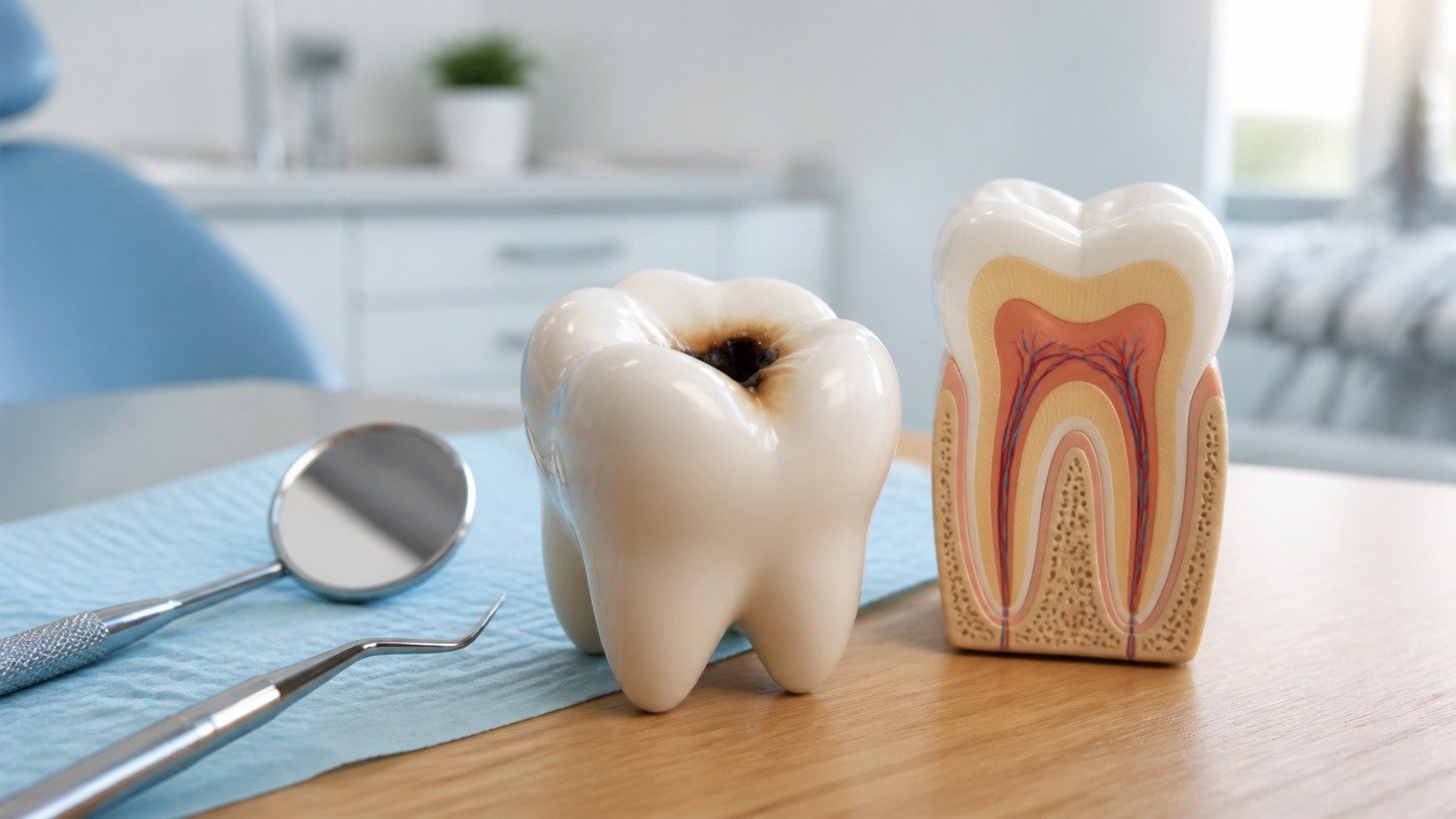
A cavity does not follow a predictable countdown. Some areas of early mineral loss can be stopped or reversed before a hole forms, while a true cavity is permanent tooth damage that generally needs professional treatment. The practical answer is to schedule the examination soon rather than waiting for pain: earlier decay is usually easier to manage, and a tooth can become deeply decayed before it hurts.
Why there is no single safe waiting period
“Cavity” is often used for several different stages of tooth decay. An early non-cavitated area may be losing minerals while the enamel surface is still intact. With the right professional plan, fluoride, plaque control and changes in eating habits may help arrest or reverse that early stage. Once the enamel has broken down and a physical hole has formed, the lost tooth structure does not grow back.
The speed of progression varies. It can be influenced by the cavity’s location and depth, saliva, fluoride exposure, dry mouth, snacking frequency, oral hygiene, tooth anatomy, existing fillings, age and overall cavity risk. That is why two spots that look similar to a patient can need different treatment timelines.
How tooth decay progresses
| Stage | What may be happening | What a dentist may discuss |
|---|---|---|
| Early mineral loss | The enamel surface is still intact, sometimes with a chalky white or brown area. | Fluoride, improved plaque control, diet changes, sealants or another nonrestorative approach, with monitoring. |
| Enamel cavity | The surface has broken down and bacteria can remain inside the defect. | A filling or another restorative treatment, depending on size and location. |
| Decay into dentin | Decay has reached the softer layer beneath enamel and may progress more quickly. | Removal or management of decay and a filling, inlay, onlay or crown depending on remaining tooth structure. |
| Decay near or into the pulp | The nerve and blood-vessel tissue inside the tooth is irritated or infected. | A protective pulp treatment, root canal treatment or extraction, based on the diagnosis and restorability of the tooth. |
| Abscess or structural failure | Infection may spread around the root, or the weakened tooth may fracture. | Urgent treatment to address infection, pain and whether the tooth can be saved. |
Progression is not always visible in a mirror. Decay can begin between teeth, beneath a contact point, around an older restoration or on an exposed root surface. Those areas may look small from the outside while extending farther underneath.
Can a cavity get worse without hurting?
Yes. Enamel has no nerves, and early decay may be painless. Even decay into dentin can be quiet for a time. Pain often appears when the tooth is more irritated, the cavity is deep, food is packing into the area, the tooth has cracked or the pulp is involved.
Waiting for pain is therefore not a reliable way to decide when to treat a cavity. A tooth that begins to ache spontaneously, wakes you at night or has lingering pain after hot or cold exposure may require more than a routine filling.
Signs a cavity may be getting worse
- New or increasing sensitivity to cold, heat or sweets.
- Pain that lingers after the temperature stimulus is gone.
- Sharp pain when biting or releasing the bite.
- Food repeatedly catching in the same spot.
- A rough edge, visible hole, dark area or piece of tooth breaking away.
- Spontaneous aching, throbbing or pain that interrupts sleep.
- Swelling, drainage, a pimple-like bump on the gum, fever or a bad taste.
These symptoms do not prove that decay is the cause; cracks, worn fillings, gum recession and other conditions can feel similar. An examination is the way to identify the source.
How a dentist decides whether a cavity needs a filling
The decision is not based on color alone. A dental examination may include drying and viewing the tooth, checking surface texture, reviewing your symptoms and cavity risk, and taking bitewing or other clinically appropriate X-rays. Existing images can also be compared over time when monitoring an early area.
Your dentist considers whether the surface is intact or cavitated, whether the lesion appears active, how far it extends, whether it can be kept clean, the strength of the remaining tooth and whether an older filling is leaking or fractured. The goal is to preserve healthy tooth structure while treating disease before it causes a larger problem.
Does every early cavity need drilling?
No. Early decay that has not formed a physical hole may sometimes be managed without a filling. Evidence-based options can include fluoride products, sealants, resin infiltration or silver diamine fluoride in selected situations. The appropriate choice depends on the tooth, surface, age, appearance of the lesion, ability to keep the area clean and the patient’s overall cavity risk.
Once there is a true cavity that cannot be kept clean, a restoration is commonly recommended. Home care can reduce future acid attacks, but it cannot rebuild a missing wall of enamel or remove decay hidden inside a hole.
What can happen if treatment is delayed
A small restoration may become a larger filling. If decay removes too much supportive tooth structure, the tooth may need an onlay or crown. If bacteria reach the pulp, root canal treatment may be needed to save the tooth. A tooth that is too damaged or fractured to restore may need extraction.
Delay does not guarantee that one of these outcomes will occur, but it gives active disease more time to progress. It can also turn a planned visit into an urgent appointment because of pain, swelling or a broken tooth.
How soon should you make the appointment?
Book promptly
If a cavity was found at a recent exam and you have no symptoms, follow the treatment timing recommended by the dentist. If the recommended date is unclear, call and ask whether the area is early and being monitored or whether a filling is already advised.
Call for an earlier visit
Ask to be seen sooner for increasing sensitivity, pain when biting, a piece of tooth breaking, food trapping with soreness, spontaneous pain or a lost filling over the area.
If an existing filling has come out, see our guide to filling replacement for that situation.
Seek urgent help
Prompt assessment is important for facial or jaw swelling, fever with dental pain, drainage, severe pain that is difficult to control, or difficulty opening the mouth. Trouble breathing or swallowing and rapidly spreading swelling require emergency medical care.
What to do while waiting for a filling appointment
- Brush twice daily with fluoride toothpaste and clean gently between the teeth.
- Limit frequent sugary or starchy snacks and sweetened drinks between meals.
- Rinse with water after eating when brushing is not practical.
- Avoid repeatedly chewing hard foods on a weakened or painful tooth.
- Do not place aspirin, alcohol, clove oil or household filling material directly into the cavity.
- Call the office if symptoms change rather than waiting for the scheduled date.
If you use an over-the-counter pain medicine, follow the product label and choose only a medicine that is safe with your health conditions and other medications. A pharmacist can help with medication questions.
What if cost or insurance is causing the delay?
Ask the dental office for a written estimate and whether the examination or X-rays are separate from the filling. If you have insurance or Health First Colorado Medicaid, the office can verify available information, but the final benefit depends on the plan and the service completed.
It is also reasonable to ask which tooth is the highest priority if several areas need treatment. Addressing the most active or deepest problem first can help create a practical plan without ignoring the others.
Cavity and filling FAQs
How long can you safely wait to fill a cavity?
There is no single safe timeframe. It depends on whether the area is early or already cavitated, its depth and activity, the tooth and your risk factors. If a dentist recommended a filling, schedule it within the advised timeframe and call sooner if symptoms begin or worsen.
Can a cavity heal on its own?
Early mineral loss can sometimes be arrested or reversed while the enamel surface is still intact. Once a physical hole has formed, the missing tooth structure does not grow back and usually needs professional restoration.
Can a cavity become a root canal problem?
Yes. If decay progresses through enamel and dentin and irritates or infects the pulp, root canal treatment may be needed to save the tooth. Treating decay earlier can reduce that risk, although each tooth must be diagnosed individually.
Why does my cavity not hurt?
Early decay often does not hurt because enamel has no nerves. A tooth can also have deeper decay before symptoms become obvious. Pain is not a dependable measure of cavity size.
Can I stop a cavity from getting worse while I wait?
Fluoride toothpaste, careful plaque removal and reducing frequent sugar exposure can reduce additional acid attacks, but they do not replace the treatment plan. Call the office if the tooth becomes painful, breaks or develops swelling.
How does a dentist know how deep a cavity is?
The dentist combines a clinical examination, symptoms, cavity-risk information and clinically appropriate X-rays. No single test tells the whole story, and the true extent may become clearer when the area is treated.
Does a small dark spot always mean a cavity?
No. Staining can collect in grooves without a cavitated lesion, while some cavities between teeth are not visible to the patient. A dental examination is needed before deciding whether monitoring, preventive care or a restoration is appropriate.
When is tooth decay an emergency?
Call promptly for severe or rapidly worsening pain, swelling, fever, drainage, a bad taste, a broken tooth or difficulty opening the mouth. Trouble breathing or swallowing and rapidly spreading facial or neck swelling require emergency medical care.
Need a cavity checked in Denver?
Star Dental provides dental examinations, X-rays when clinically needed and tooth-colored fillings for adults and children. The office is open seven days and welcomes patients from Denver, Lakewood and nearby communities.
Sources
- National Institute of Dental and Craniofacial Research: The Tooth Decay Process
- American Dental Association: Caries Risk Assessment and Management
- American Dental Association MouthHealthy: Cavities
- American Dental Association MouthHealthy: Composite Fillings
- Centers for Disease Control and Prevention: Cavity Facts