
A permanent tooth can appear behind a baby tooth before the baby tooth falls out. Parents sometimes call this a double row or ‘shark teeth.’ It does not automatically mean the baby tooth needs removing. Call your child’s dentist to describe what you see; the tooth’s position, your child’s development, symptoms and whether the baby tooth is loose help guide the next step.
Finding a new tooth while brushing can be surprising. You do not need to identify the tooth or decide on treatment yourself. This guide helps you prepare for that conversation and recognize changes that should not be treated as an ordinary eruption question.
Why can an adult tooth come in behind a baby tooth?
During the change from baby teeth to permanent teeth, both sets are present in the mouth. Sometimes a permanent front tooth becomes visible on the tongue side while its baby-tooth predecessor is still there. This lower-front-tooth pattern has been documented in research following children with permanent incisors erupting behind baby incisors. It is a description of the position, not a diagnosis of the cause in your child.
The ADA’s eruption charts show that different teeth arrive and are lost at different stages. A chart can help explain the overall sequence, but an age range cannot tell you whether a particular retained baby tooth should be monitored or treated.
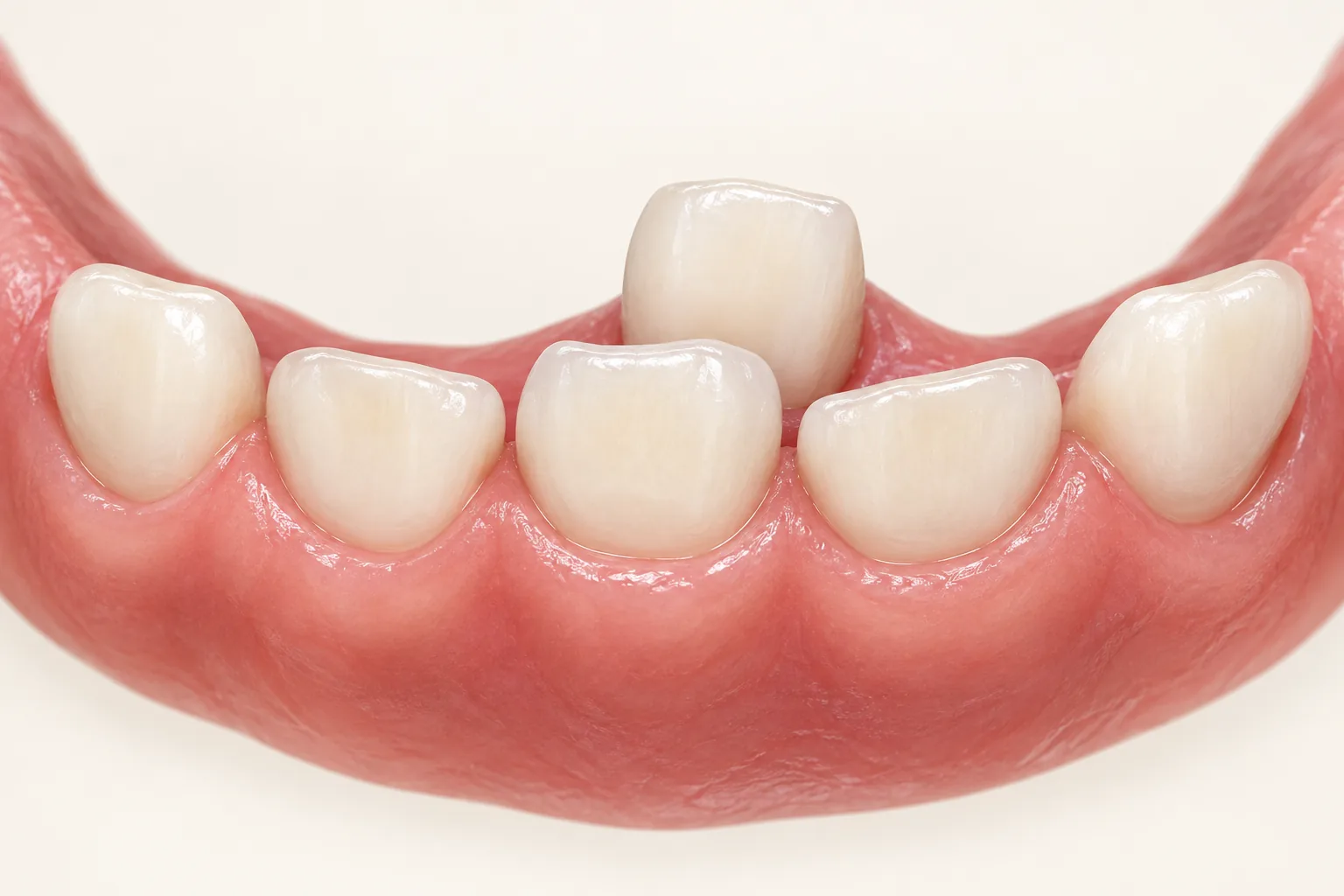
Check what “behind” means: a new front tooth on the inside of an existing front tooth is different from a new molar at the very back of the mouth. First permanent molars normally arrive behind the baby molars without replacing a baby tooth. NHS dental guidance describes these back teeth appearing from around age six. Tell the office whether the new tooth is near the front or at the end of the row.
The baby tooth is loose—or it is not loose. What should you say?
Looseness is useful information, but it is not a home test for whether the situation is safe to leave alone. There is no need to repeatedly move the tooth to prove how loose it is. Use what your child has noticed and let the dentist examine it.
| What you notice | What to tell the office | A useful question |
|---|---|---|
| The baby tooth is already loose | When the new tooth appeared and whether there is discomfort or difficulty eating. | “Should this be checked before our next planned visit?” |
| The baby tooth still seems firm | The new tooth’s location and how long you have noticed it. | “Can we arrange an eruption check and discuss the options?” |
| You cannot tell which tooth is new | Describe the front or back, upper or lower, and any recent tooth loss or injury. | “What information would help you schedule the assessment?” |
For example, “a new tooth is behind a lower front baby tooth, and the baby tooth does not seem loose” is enough to start the call. You do not need to press on the gum, measure the gap or choose an extraction appointment.
When should you arrange a dental appointment?
If your child is comfortable and you have noticed only a second row, contact the dental office for advice about an appropriate examination. Do not use a universal online deadline—such as waiting a certain number of weeks—for every child. Ask the team when they want to see your child and what changes should prompt an earlier call.
Report pain that persists or worsens, swelling, pus or a bad taste, fever, or difficulty eating when calling. Mention any fall or blow to the mouth, even if it happened before the new tooth became noticeable. Symptoms need their own assessment; do not assume that everything is caused by the tooth coming through. Our children’s dental care page explains the practice’s examination and urgent-care approach.
Seek emergency medical care for trouble breathing or swallowing or severe, spreading mouth or facial swelling; call 911 for breathing difficulty. Do not wait for an online appointment request to be answered. These warning signs are consistent with NHS guidance on serious dental infection; they are not a prediction that a second row will become infected.
What will the dentist check?
The dentist identifies the teeth, checks the baby tooth’s mobility and health, and considers the emerging tooth’s position, available space and bite. Previous injury or dental treatment can matter. The AAPD’s developing-dentition guidance emphasizes diagnosis and a treatment plan suited to the child rather than treating every eruption difference alike.
X-rays are selected when they would help answer a clinical question, such as the position of teeth that cannot be assessed fully by looking. They are selected individually rather than automatically required at every visit. The ADA’s X-ray guidance explains that the history and examination guide this decision. Tell the office about recent images from another dentist and ask how useful records can be transferred.
Before the appointment, write down:
- Your child’s age and when you first noticed the new tooth.
- Whether the area hurts, affects eating or has changed since then.
- Whether that baby tooth has been injured, filled or otherwise treated.
- Any current medicines, health concerns or previous difficulty with dental visits.
Ask the dentist to show you which tooth is the baby tooth and which is its replacement. That makes the explanation easier to follow and helps you describe changes accurately afterward.
Does the baby tooth always need to be removed?
No. In a two-year study of 105 children with lower permanent incisors erupting on the tongue side, some baby incisors were lost without intervention, while some children needed extraction. Those findings do not provide a waiting period or predict the outcome for one child; they show why “always pull it” is not a sound general rule.
If monitoring is recommended, ask what the dentist is watching for and when to return. If removal is recommended, ask why that tooth needs removing, what the alternatives are and what follow-up will still be needed. The AAPD’s pediatric oral-surgery guidance discusses planning around the developing permanent teeth and explaining treatment choices to families. Removal is a professional treatment decision, not something to copy from a home video.
Make the follow-up plan concrete: “Which tooth are we watching?”, “When should you check it again?” and “Should we call if the baby tooth falls out before that visit?” A planned review is different from simply waiting until there is pain.
What should you do—and avoid—at home?
- Keep the area clean. Help your child reach the new tooth and the inside surfaces with a soft toothbrush and age-appropriate fluoride toothpaste. Ask for a demonstration if the two rows make access awkward. The ADA recommends gentle brushing twice daily.
- Do not force the baby tooth out. Avoid string, pliers, household tools or pressure from an adult’s fingers. Do not cut the gum or try to move the permanent tooth.
- Do not turn meals into a pulling test. If biting hurts, report it rather than asking your child to bite harder to loosen the tooth.
- Keep the explanation calm. “The dentist will look at how your teeth are growing” is a useful way to describe the visit. Do not promise that nothing will be done or tell your child in advance that a tooth must come out.
If your child is anxious, tell the office when booking. Our first dental visit guide has preparation ideas. An eruption concern can be assessed without making a child responsible for deciding what treatment is needed.
Common questions about “shark teeth”
Will the adult tooth definitely straighten after the baby tooth falls out?
No position can be guaranteed. Space, the bite and the eruption pattern affect the assessment. Keep the recommended follow-up rather than assuming that losing the baby tooth completes the plan.
Does a second row mean my child will need braces?
Not automatically. The dentist evaluates the overall developing bite and may recommend monitoring or an orthodontic opinion when appropriate. One visible tooth position cannot establish a complete orthodontic plan.
Is the new tooth an extra tooth?
Not necessarily: a permanent replacement and a baby tooth may be visible together. An actual extra, or supernumerary, tooth is a different finding. The dentist identifies and counts the teeth and uses imaging when needed to clarify the situation.
What if it is an upper tooth rather than a lower front tooth?
Tell the dentist its location. Advice about a lower front tooth should not automatically be applied to an upper tooth or another eruption pattern. Arrange an individual assessment instead of using another child’s treatment as the guide.
Can a photograph tell us whether the baby tooth needs pulling?
A photograph may help explain where the new tooth is, if the office requests one through an appropriate channel. It cannot assess everything beneath the gum or replace checking the tooth and bite. Ask how the office wants to evaluate the concern before sending images.
Arrange a dental assessment for your child
Call Star Dental at 303-222-1414 to arrange a dental assessment for your child in Denver. Tell the team that a permanent tooth is appearing behind a baby tooth and describe any symptoms. Call first to reserve an appointment before coming in; treatment depends on the examination.
If your child uses Health First Colorado, review the existing children’s dental benefits guide and ask the team to verify eligibility and benefits for the recommended care. This article cannot confirm coverage or the need for a procedure.
Prepared by Star Dental. General educational information; an examination is needed to advise on your child’s teeth.
Sources and editorial information
Prepared by Star Dental. This guide explains general dental care; your dental team’s examination and instructions guide your individual care.
- AAPD: Management of the Developing Dentition and Occlusion in Pediatric Dentistry
- Primary study: Lingual eruption of mandibular permanent incisors: a space correlated phenomenon?
- ADA MouthHealthy: Eruption Charts
- ADA MouthHealthy: X-rays
- AAPD: Management Considerations for Pediatric Oral Surgery
- ADA MouthHealthy: Brushing Your Teeth
- Wirral Community Health and Care NHS Foundation Trust: Dental self-care advice
- NHS: Dental abscess